
Hello. I’m Peter Bonate.
I've spent my career using mathematical models to explain how drugs work in animals and humans.

Pharmacometrician.
Clinical Pharmacologist.
Model Communicator.
About Me
I lead the Modeling and Simulation Group in the Early Development and Translational Sciences Department at Astellas. I have more than 30 years of experience in the pharmaceutical industry, working in pharmacometrics, clinical pharmacology, and drug metabolism and bioanalysis. Prior to Astellas, I held scientific and leadership roles at GlaxoSmithKline, Genzyme, Hoechst Marion Roussel, Eli Lilly, and Quintiles.
Over the course of my career, I have served as lead clinical pharmacologist on the development of a wide range of therapeutics, including monoclonal antibodies, enzymes, peptides, DNA vaccines, and small molecules. These programs span early- and late-stage development and include oncology, infectious disease, and rare and orphan indications. I have been directly involved in first-in-human studies, clinical pharmacology programs, CTDs, and FDA advisory committee meetings, and I have worked extensively on products that ultimately reached regulatory approval.
My scientific focus has long been on applying pharmacokinetics, pharmacodynamics, and modeling and simulation to improve decision-making in drug development. I am particularly interested in methodological innovation and was an early adopter of linear mixed-effects models for QTc analysis in the 1990s. More recently, my research interests have expanded to include the application of machine learning in pharmacometrics and statistical approaches to the analysis of rare events in clinical trials.
I have authored more than 80 peer-reviewed publications and co-edited the four-volume Pharmacokinetics in Drug Development series. I am also the author of Pharmacokinetic–Pharmacodynamic Modeling and Simulation (second edition), which has been widely used in academia and industry and has accumulated more than 50,000 chapter downloads. In addition, I wrote Be a Model Communicator (and Sell Your Models to Anyone) to help scientists communicate quantitative ideas more effectively.
I am a Fellow of the American College of Clinical Pharmacology, the American Association of Pharmaceutical Scientists, and the International Society of Pharmacometrics. I have served on ISoP's Board of Directors. I am currently Editor-in-Chief of the Journal of Pharmacokinetics and Pharmacodynamics and an Associate Editor of Pharmaceutical Statistics.
Throughout my career, I have been most motivated by mentoring scientists, advancing quantitative thinking in drug development, and bridging the gap between complex models and real-world decisions.
What I Do
What I do is bridge data and decision-making in drug development. I mostly work in early development, where the goal is to turn promising molecules into medicines that have a real chance of helping patients. My role is to lead teams that use quantitative approaches, such as population pharmacokinetics, statistics, and modeling and simulation to inform decision-making as early, clearly, and rigorously as possible.
In practical terms, that means helping teams understand how a drug behaves in the human body, how drug concentrations relate to efficacy and safety, and how uncertainty should be managed as programs move forward. I’ve worked across a wide range of modalities, including small molecules, monoclonal antibodies, enzymes, peptides, and DNA vaccines, and across therapeutic areas such as oncology, infectious disease, and rare and orphan disorders. My experience spans from preclinical to first-in-human studies through late-phase development.
A core part of what I do is to develop mathematical and statistical models that understand the relationships among dose, drug concentrations in the body, and how those concentrations affect both safety and efficacy. Those results are then translated into insights that teams can act on. Models are only useful if they impact decisions, so I spend a lot of time bridging the gap between quantitative methods and the scientists, clinicians, and leaders who rely on them. Earlier in my career, I helped pioneer approaches such as population pharmacokinetics and linear mixed-effects modeling for QTc analysis; more recently, my interests have expanded to machine learning and statistical methods for rare events in clinical trials.
Beyond project work, I care deeply about advancing the field itself. I publish, edit journals, write books, and mentor scientists because I believe good quantitative thinking improves not just individual programs, but the entire discipline. At the end of the day, what motivates me is mentoring junior scientists and helping teams make better, more transparent decisions—decisions that increase the odds that the right drugs reach the right patients at the right time.

Drugs Explained
My New Book is Out!
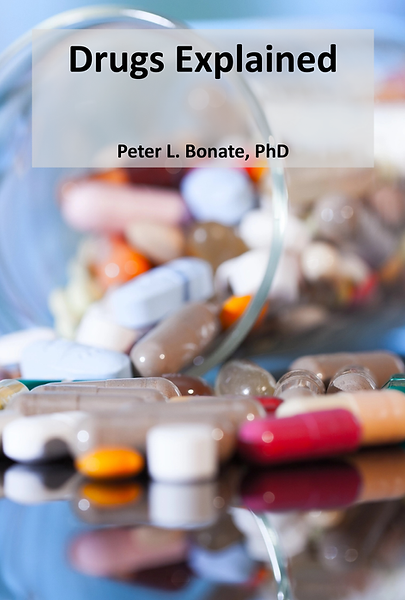
We rely on medications to treat a wide range of illnesses, from the common cold to serious conditions like cancer. Despite how frequently drugs are used in modern medicine, many people have little understanding of how they are developed or how they work in the body.
Drugs Explained is an open-source book takes the mystery out of medications. Learn how drugs are developed, how they work inside your body, and what all that fine print on medication labels really means. Finally understand the science behind your medicine cabinet!
Website Notes
If you are having trouble viewing the headers or buttons in windows that are not full-size because they are too large and are crowding the page, this is a feature of Wix, the website builder I used. Apparently, the Wix Editor does not handle scaled proportional fonts or headers. They have known about this for years and still have not fixed it. Maybe if more people draw attention to it, this will get them moving on it.
If you like the colors of this website, I've taken them from the book by Teruko Sakurai. Traditional Colors of Japan: The Complete Guide for Designers and Graphic Artists. Tuttle Publishing, Tokyo, 2021. I love this book. It's beautiful. Thanks to my friend, Walter Krauwinkel, for pointing this book out to me. There is also a website. After alot of trial and error, I settled on Hakuba Valley and Happo Pond (p 198). Headers and footers are Large Snowy Gorge (F0F7FB). Strips are Mountain Torrent (CBDAF0), Happo Pond (6E93CC), and Hakuba Yarigatake (DBE6D4).